Spades Royale
- 4.7
- Rating
- 5.00M
- Installs
- Free
- Price

 Analysis by App-foxy
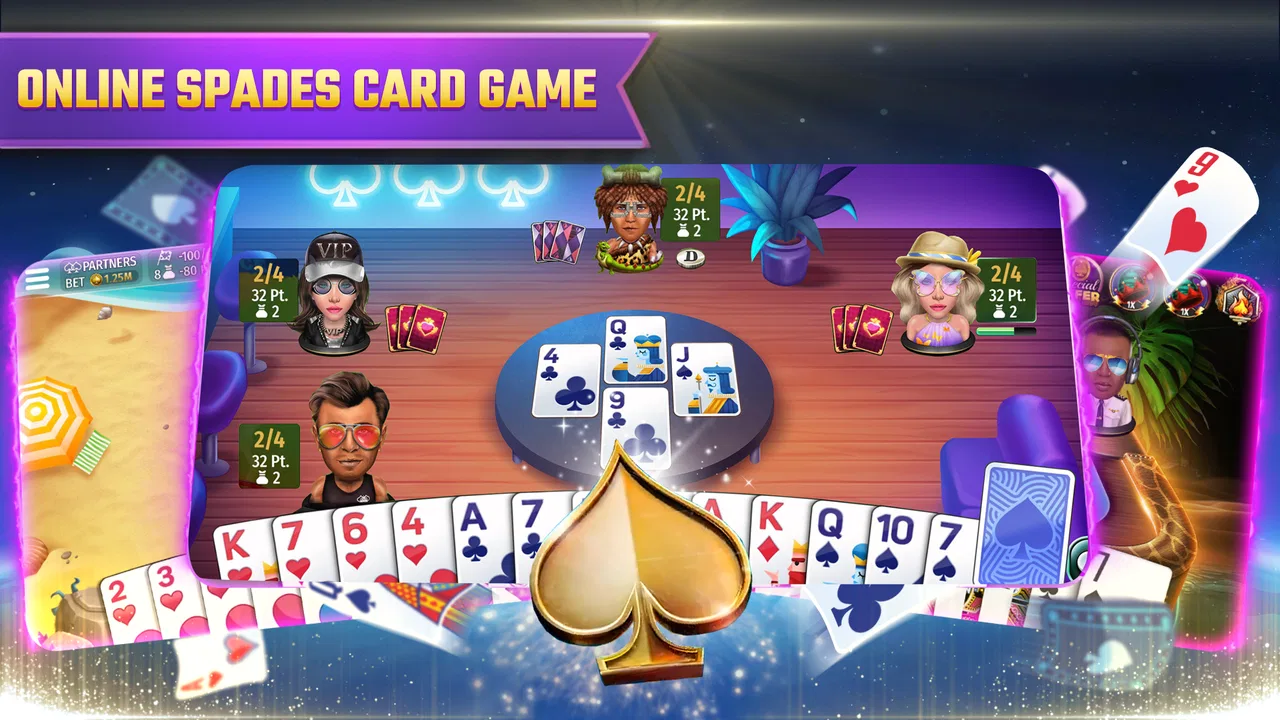
I found Spades Royale easy to pick up and surprisingly difficult to play well. It is a free card game from Beach Bum Ltd. built around Spades, so the basic task is familiar: judge the strength of your hand, bid on how many tricks you expect to take, and then try to deliver exactly that result while your opponents do the same. The appeal is immediate because every hand creates a small decision problem, but the lasting question is whether that loop remains interesting after the first burst of curiosity.
My answer is cautiously positive. This is a good choice if you already enjoy trick-taking games, want short competitive sessions, or like the social feeling of playing cards with friends without setting up a physical table. It is less convincing for someone looking for a deep strategy game with a large range of modes or a completely relaxed experience. The game can be friendly and tense at the same time, but its strongest moments depend on your tolerance for repeated hands, changing partners, and the pressure of making a bad bid visible to everyone.
What the first week feels like
The first few sessions are carried by the rules themselves. Spades has a clean rhythm: look at your cards, estimate your tricks, make a bid, follow suit when possible, and decide when to spend a high card or let a trick go. That structure gives each hand a clear beginning, middle, and end. I never felt lost about what I was supposed to do, even when I made a poor decision.
You May Also Like

 Blood Strike: 2.5 Anniversary
Blood Strike’s Loadouts Turn Every Drop Into a Tactical Gamble
A close look at Blood Strike’s custom loadouts: how fast access to signature weapons reshapes its battle royale rhythm, rewards preparation, and narrows the gap between fights.

 Pandora - Music & Podcasts
Pandora’s Music Is Easy to Start, but Harder to Recover
Pandora’s strength is its low-effort path from a seed to a station. Its weak spot is how much confidence it asks you to place in connection, setup, and quiet recovery.

 8 Ball Pool
 Is Built on Rivalries, Rematches, and Routine
A close look at the rivalries, rematches, shared routines, and unanswered safety questions that turn a quick pool match into a persistent mobile community.

 Samsung Music
’s Quiet Strength Is Playing What You Already Own
Its reach comes less from spectacle than from dependable access to a personal library. That simplicity is both the app’s strongest retention engine and its ceiling.

 AccuWeather: Weather Radar
AccuWeather Review: A Quick, Clear Forecast for Everyday Decisions
For everyday plans, the best forecast is the one you can understand quickly. AccuWeather makes rain timing, radar, and local conditions easy to act on, with a few trade-offs.

 Hill Climb Racing
Why Hill Climb Racing Still Turns Crashes Into One More Run
A tiny car, a bumpy hill and one more upgrade: Hill Climb Racing keeps resurfacing because its simple chaos makes every near-miss feel personal.
More From Our News Desk



The important distinction is that the game is not only about collecting strong cards. A hand with several high cards can still be awkward if the suits do not work together, while a modest hand may become useful when the bidding and play develop in the right direction. I found myself paying attention not just to what I held, but also to which suits had already disappeared and whether another player was likely saving a Spade for a later trick.
That makes the opening week more engaging than a simple luck-based card app. Luck matters, naturally, but the game gives you enough control to review your choices. When a round goes badly, I can usually identify the moment I overbid, used a winning card too early, or assumed a partner would cover a situation that was never safe. That feeling of responsibility is one of the reasons the game can become a habit rather than a quick novelty.
The social angle also matters. The store summary presents it as a game for friends, and that description fits the experience better than treating it as a solitary puzzle. Playing with people I know gives the bids and tricks more meaning because a risky decision becomes something to discuss afterward. Even when I play against unfamiliar opponents, the table feels more lively than a purely offline card game because every move has an implied audience.
Still, new players should expect a learning curve that is more about judgment than rules. The instructions may tell you how a trick works, but they cannot instantly teach you how aggressively to bid with a short suit, when to protect your partner, or how to read a sequence of discarded cards. I recommend spending the first sessions observing patterns instead of chasing every possible trick. A conservative bid that succeeds is often more valuable than an ambitious bid that looks clever and collapses the whole hand.
One useful habit is to separate “cards I can win” from “tricks I can safely promise.” Those are not the same thing. A high Spade may win one trick, but if it is your only reliable winner, bidding as though the rest of the hand is equally secure is a common mistake. I also found it helpful to remember the bids at the table before play begins. The total expectation created by those bids gives context: if several players have made confident calls, a cautious hand may be more valuable as damage control than as an opportunity to overtake the table.
The practical strengths of the card loop
The best part of the design is its compact decision cycle. A hand does not require a long uninterrupted commitment, yet it contains enough information to reward attention. That makes it suitable for a short break, a commute, or a few rounds while waiting for an appointment. I can stop after a hand without feeling that I abandoned a large campaign or lost hours of progress.
Another strength is how naturally the game creates stories. A successful nil-style gamble, a carefully delayed Spade, or a partner’s unexpected save can make an ordinary round memorable. Those moments are not guaranteed, but they emerge from the rules rather than from scripted events. For me, that is more durable than a flashy opening presentation because the entertainment comes from decisions I made with the cards in front of me.
There is also a useful middle ground between casual play and serious concentration. I can play loosely when I only want a distraction, but the same table becomes more demanding when I track the suits and estimate what remains in other hands. Players who enjoy gradually improving through observation will get more from it than players who only want instant rewards.
Why it may or may not survive the first month
The month-to-month value depends heavily on whether you enjoy repetition with variation. The rules do not need to change for every session to feel different, because the hands, bids, partners, and mistakes change the texture of play. That is the same reason traditional Spades remains playable for years: the framework stays stable while the decisions inside it keep moving.
In my experience, the game earns recurring space when I approach it as a skill practice rather than a reward machine. I might set a small personal goal, such as avoiding speculative bids, remembering which suits have been exhausted, or protecting a partner’s likely plan. Those goals make ordinary matches feel purposeful. Without them, a losing streak can make the game feel like I am simply waiting for better cards.
For a group of friends, the long-term case is stronger. A familiar group can develop its own table habits, discuss questionable bids, and turn a few hands into a regular social ritual. The game is especially suitable for friends who already know Spades because the app removes the need to shuffle, deal, and keep score manually. It is not a substitute for every kind of social game, but it can preserve the conversational rhythm of a card table when everyone is playing remotely or at different times.
For a solo player, the value is more conditional. If you enjoy testing yourself against changing opponents and refining your estimates, the core loop can remain satisfying. If you need a steady stream of new rules, story content, or puzzles, the familiar structure may feel narrow after the initial period. I would not choose this as my main mobile game if I wanted exploration, character progression, or a campaign with a clear ending.
The audience response suggests that the game has reached a substantial player base: it carries a 4.7 average from around 274 thousand ratings and has passed 5 million installs. Those figures do not guarantee that every table will suit me, but they do indicate that this is not an obscure experiment with a tiny audience. The presence of roughly 100 thousand written reviews also means prospective players can expect an established, actively used card experience rather than an empty matchmaking environment.
That said, a large audience can bring its own friction. A popular competitive table may include players with very different expectations. Some people will treat every bid as a serious contest, while others will play quickly and take risks for amusement. I have to decide whether I am willing to accept that inconsistency. If I need a controlled, quiet practice environment, a traditional offline Spades app may be a better fit. If I want human unpredictability and social pressure, this game has the advantage.
How I would build it into a routine
I would not open it without a limit when I am already tired. Repeated hands can blur together, and frustration makes bidding worse. A better routine is to play a small block of rounds, then stop after a hand that gives me something to think about. That keeps the game associated with a satisfying decision instead of an endless attempt to repair a bad session.
Another practical approach is to use it as a social appointment rather than a background distraction. Agreeing with friends to play for a short period gives the game a purpose and reduces the temptation to chase losses. It also makes the app’s strongest feature—the shared table—more visible than simply launching random matches whenever I have a spare minute.
Players who are new to Spades should focus on three checks before every bid. I ask how many likely winners I have, whether my suits create dangerous voids, and what I can do if the first plan fails. That third question is easy to ignore. A hand may look strong until an opponent leads the one suit that forces me to spend a key card. Thinking about the fallback plan improves consistency more than memorizing isolated tricks.
Maintenance, spending, and everyday friction
Because the game is free, the initial commitment is low. It is available for devices running Android 7.0 or later, and its content rating is Teen. That makes it accessible to a broad mobile audience, although the competitive and social nature means parents should still consider whether the style of interaction suits a particular teenager.
The current version is 3.3.481, which is useful context for anyone deciding whether to install it today. I would keep the app updated through the normal store process, especially for a game that depends on online social play and a current player community. Updating is not a gameplay strategy, but it is part of keeping a multiplayer card app comfortable to use over time.
The main maintenance burden is not complicated setup. It is attention. To get the best experience, I need to remember the bidding logic, watch the suits, and accept that some rounds will be decided by a combination of card distribution and partner behavior. If I only want to tap through turns while watching something else, I lose much of what makes Spades interesting and may also make the table less enjoyable for others.
There are in-app purchases ranging from $0.99 to $379.99 per item. That wide range is the clearest reason I would recommend setting a personal spending boundary before playing. The game is free to start, but “free” should not be confused with frictionless if I am tempted by optional purchases. I would treat any purchase as entertainment spending, never as a requirement for proving that I am a better player.
This is also where the game may not suit people who dislike monetized mobile card apps. Even if I can enjoy the underlying rules without spending, the presence of purchasable items can affect how I feel about the overall experience. Someone who wants a one-time purchase with no ongoing commercial pressure may be happier with a paid, offline Spades game. Someone who values social access and a free starting point may consider the trade-off reasonable.
For everyday use, the app works best when I have a stable enough moment to follow a hand. I would choose it over a long-form game during a lunch break because a few rounds can feel complete. I would not choose it during a rushed task or while walking, since missing a suit or misreading a bid can ruin the hand. The game asks for more concentration than its simple card interface first suggests.
Where fatigue begins
The most obvious source of fatigue is the repetition of the central loop. The rules are elegant, but elegance can become sameness when I play too many hands in one sitting. The game does not need to reinvent Spades, yet players who require constant novelty may eventually feel that every session is another variation of the same argument with the deck.
Losses can be tiring for a second reason: not all frustration feels under my control. A thoughtful bid can still fail because the cards do not cooperate, and a partner’s decision can change the outcome of a hand I thought I understood. That uncertainty is part of the social card-game appeal, but it can also make progress feel uneven. I have to be comfortable judging my play over many hands instead of demanding that each round reward me.
Partner dependence deserves special attention. Spades is not only an individual contest, so a player who prefers complete control may dislike the experience. I can make a sensible bid and still face a difficult recovery if the partnership does not coordinate. With friends, that becomes conversation and shared learning. With strangers, it can become the reason I close the app.
The competitive atmosphere may also be a poor match for players seeking calm. Even without aggressive behavior, bidding creates pressure, and a missed opportunity is easy to replay mentally. I would recommend it to someone who enjoys low-stakes tension, not to someone who wants a soothing card solitaire session. For that person, a solo alternative with no partner or opponent would be more comfortable.
There is a less obvious fatigue point in the gap between knowing the rules and understanding the table. New players may feel competent quickly because the turn structure is clear, then become discouraged when experienced opponents consistently make better bids. The remedy is not to play recklessly in an attempt to catch up. I found more improvement by reviewing whether my bids were realistic, especially when I was tempted to count every possible winner as guaranteed.
One advanced but practical insight is to treat the first few tricks as information gathering. I do not need to reveal every strength immediately. Watching who is void in a suit, who spends a Spade early, and who appears to be protecting a bid can tell me more than winning one extra trick. This approach is particularly useful when my hand is uncertain: I can preserve flexibility until the table gives me evidence.
Another trade-off is speed versus accuracy. Fast play keeps the social energy moving, but it encourages automatic bids and careless card choices. Deliberating over every turn can improve decisions while making the session feel heavy. I prefer a middle ground: pause before the bid and before a key lead, then play routine follow-suit decisions quickly. That keeps the game lively without turning the important moments into guesses.
My long-term verdict
After the novelty fades, Spades Royale earns a place on my device when I want a social trick-taking game that is quick to start and deep enough to reward attention. Its lasting value comes from the decisions inside each hand, not from a promise of endless new content. If I enjoy reading a table, managing risk, and laughing about a disastrous bid with friends, I can return to it regularly.
I would skip it if I dislike partner-based competition, become irritated by unlucky hands, or want a fully offline experience with a simple one-time purchase. I would also be cautious if mobile in-app purchases make me uncomfortable, given the stated purchase range. In those cases, a traditional physical deck with friends or a straightforward offline card app may offer a cleaner fit.
For everyone else, my recommendation is to judge it over several short sessions rather than one lucky first impression. Learn to bid conservatively, watch what the table reveals, and decide whether the social uncertainty feels exciting or exhausting. That test tells me more than a single winning streak. The game is at its best when I use it as a compact meeting place for card strategy, not as a machine for endlessly chasing the next reward.
Beach Bum Ltd. has chosen a familiar foundation, and that familiarity is both the product’s strongest asset and its main limitation. Spades Royale does not need complicated rules to hold attention, but it does need a player who enjoys practicing judgment. For me, it passes the long-term test with conditions: worthwhile for regular card players and friend groups, enjoyable in measured sessions, and less suitable for anyone seeking novelty, solitude, or a completely pressure-free pastime.
FAQs for Spades Royale
01What is Spades Royale and how does it differ from traditional Spades?
Spades Royale is a mobile adaptation of the classic card game, Spades. It offers a vibrant online multiplayer experience where players can compete in tournaments and win prizes. Unlike traditional Spades, Spades Royale incorporates social features, allowing you to connect with friends or make new ones while playing. The game also includes leaderboards and daily challenges for added excitement.
02Is Spades Royale free to play, and are there in-app purchases?
Yes, Spades Royale is free to download and play. However, it does offer in-app purchases for players who wish to enhance their gaming experience. These purchases can include additional coins, special game features, or cosmetic items. While purchases can provide advantages, they are entirely optional and not necessary to enjoy the core game.
03What are the system requirements for Spades Royale on Android and iOS?
Spades Royale requires Android 5.0 or later and iOS 10.0 or later to ensure smooth gameplay. The app is optimized for both smartphones and tablets, making it accessible on a wide range of devices. For the best experience, it's recommended to have a stable internet connection and sufficient storage space for game updates and additional content.
04How does the multiplayer feature work in Spades Royale?
In Spades Royale, the multiplayer feature allows you to play against friends or other players worldwide. You can join existing games or create your own and invite friends to join. The game also includes a matchmaking system to pair you with players of similar skill levels. This ensures fair and competitive gameplay in every match.
05Are there any privacy concerns with Spades Royale?
Spades Royale takes user privacy seriously and complies with relevant data protection regulations. The app collects minimal personal information necessary for gameplay, such as your username and game preferences. It also provides options to manage privacy settings within the app. Always review the app’s privacy policy for detailed information on data handling.
Pros
- Smooth gameplay experience.
- Engaging multiplayer mode.
- Daily rewards and bonuses.
- Intuitive user interface.
- Variety of card designs.
Cons
- Occasional connectivity issues.
- Ads can be intrusive.
- In-app purchases are pricey.
- Lacks offline mode.
- Limited tutorial for beginners.

Spades Royale
Gallery